

Questions to Ask Yourself Before the New Year
If you want useful questions to ask yourself before the new year, start with prompts that help you look at what actually happened, what drained or sustained you, and what deserves your attention next. The goal is not to build a perfect January plan. It’s to be honest, notice patterns, and choose a few changes you can actually follow through on.
That matters because vague reflection usually leads to vague resolutions. A better approach is simple: look back, name what you learned, and turn your answers into a few specific next steps.
How to use these questions without getting overwhelmed
You do not need to answer all 25 in one deep, emotional sitting. Pick 10 if that’s what you have energy for. If you’re doing this on New Year’s Eve, keep it gentle and practical.
Try this:
- Set a timer for 20 to 30 minutes.
- Write short answers, not essays.
- Star the 3 answers that feel most important.
- Use those 3 to shape your priorities for next year.
Psychology guidance from the APA tends to favor small, attainable goals over one huge resolution, and that applies here too. Reflection works best when it leads to realistic action, not more pressure.
25 questions to ask yourself before the new year
What this year taught you
- What am I genuinely proud of this year?
Not what looked impressive from the outside. What felt hard, meaningful, or brave? - What challenged me the most, and what did it reveal?
Stress often exposes limits, needs, and habits you might not see when life feels easier. - What did I learn about what I can handle?
Maybe you became more resilient. Maybe you learned you need more support. Both count. - What disappointed me, and have I fully admitted that?
Unprocessed disappointment has a way of following you into January. - What do I want to leave behind with this year?
Be specific: one draining commitment, one harsh belief, one habit that keeps costing you.
These first five are a strong place to start if you want a shorter set of 10 questions to ask yourself before the new year. They give you a quick review without skimming past what mattered.
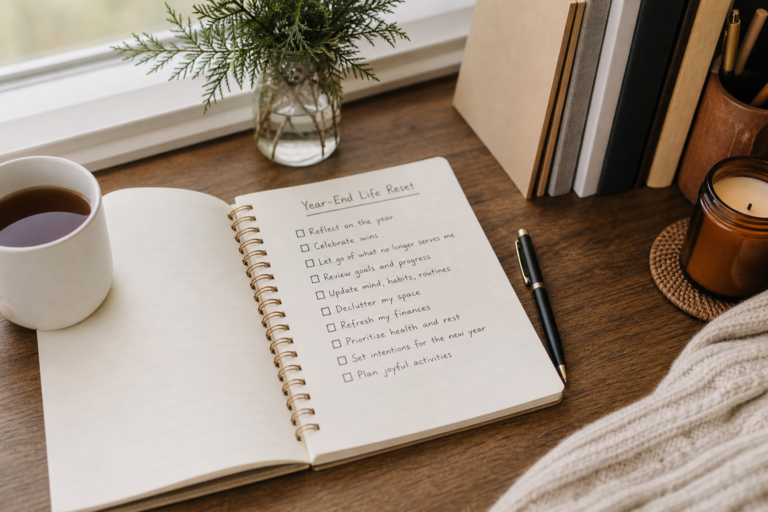
This end-of-year life reset checklist can also help if your thoughts feel scattered and you want a more structured review.

Your energy, habits, and wellbeing
- What gave me energy this year?
Name real things: morning walks, slower weekends, protein-rich breakfasts, reading before bed, less phone time. - What consistently drained me?
Look for patterns, not just bad days. Was it overcommitting, doomscrolling, clutter, late nights, certain conversations? - When did I feel most like myself?
This question often points to what your life needs more of. - What habit helped me the most?
Keep it small if needed. A 10-minute tidy, going to bed earlier, taking lunch away from your desk, stretching after work. - What habit quietly made life harder?
Many unhelpful habits are not dramatic. They’re subtle, repeated, and easy to miss. - What signs told me I needed rest, and did I listen?
Short temper, brain fog, dread, headaches, emotional numbness, trouble concentrating. Those signals matter. - What would support my mental and physical health next year in a realistic way?
Think support, not self-punishment.
If this section hits a nerve, you might find help in these signs you need emotional rest or tiny habits for better mental health when tired. Not every season is meant for major reinvention.
Your relationships and support system
- Who made me feel safe, seen, or encouraged this year?
Write their names down. Appreciation gets clearer when it’s specific. - Which relationships felt one-sided, tense, or draining?
You don’t need to judge anyone harshly. Just notice what your body already knows. - Did I ask for help when I needed it?
If not, what made that hard? - Who do I want to invest in more intentionally next year?
Maybe that means a monthly walk, a weekly call, or simply replying sooner. - Where do I need better boundaries?
Time boundaries, money boundaries, emotional boundaries, availability boundaries. Name the type, not just the idea. - Do I feel connected enough right now?
If the answer is no, your next step might need to be social, not productive.
The CDC notes that social connection is linked to better health and wellbeing, and loneliness is common enough that it deserves a place in year-end reflection. A strong year is not only about output. It’s also about who you can lean on and who feels good to be around.
Your money and practical stability
- What caused the most financial stress this year?
Unexpected car repair? Higher grocery bills? Debt? Irregular income? Name the real pressure. - Did I build any financial cushion at all?
Even a small emergency fund can reduce stress. If you want personal advice for your situation, talk with a qualified financial professional. - What expense surprised me, and how could I prepare better next time?
This matters because unexpected costs are common, not rare. - What money habit would make daily life easier next year?
Examples: automatic transfer on payday, meal planning, unsubscribing from tempting sales emails, checking your balance twice a week.
Money questions can feel less inspiring than purpose questions, but they shape your peace of mind. The Consumer Financial Protection Bureau’s guide to building an emergency fund is a useful place to start if this is an area you want to strengthen.

Purpose, direction, and what comes next
- What mattered most to me this year, based on how I actually lived?
This question compares your stated values with your calendar, spending, and attention. - What do I want more of next year?
Not just achievements. Maybe more peace, courage, margin, friendship, creativity, faith, consistency, or fun. - If I could improve one area of life by 10 percent, what would make the biggest difference?
Ten percent is enough to change how a week feels. It is also small enough to feel believable.
Questions to ask yourself going into the new year if you feel stuck
Sometimes the problem is not a lack of goals. It’s exhaustion, grief, or decision overload. If you feel stuck, ask these three simpler questions first:
- What feels heavier than it should?
- What would make this season easier?
- What is one next step I can do in the next seven days?
That’s often more helpful than forcing a big yearly vision when what you really need is recovery. If the past year has been especially hard, this guide to getting your life together after a hard year may meet you better than a standard resolution list.
How to turn your answers into a plan you’ll actually use
This is the part many reflection lists skip. Good questions are useful, but they become far more useful when you turn them into action.
1. Pick three priorities, not ten
After answering the prompts, circle the three themes that came up most. For example:
- I need more rest and a steadier routine.
- I want to improve one close relationship.
- I need to stop avoiding my finances.
That’s enough. You do not need a complete life overhaul in January.
2. Make each priority specific
Instead of “take better care of myself,” try “go to bed by 10:45 on weeknights” or “take a 15-minute walk after lunch three times a week.” Specific goals are easier to act on and easier to measure.
If mornings tend to affect your mood, you could pair this with healthy routines for dark mornings or a calmer morning routine for anxiety.
3. Plan for obstacles before they show up
Ask yourself:
- What will make this hard on busy days?
- What usually knocks me off track?
- What is my backup version of this habit?
For example, if your goal is to cook more, your backup might be three easy meals you can make in 15 minutes. If your goal is to rest more, your backup might be a no-phone 20-minute reset after work.
4. Choose a way to track progress
Research reviewed by the APA found that monitoring progress helps goal attainment, and physically recording it tends to work better than keeping it vague in your head. Tracking does not have to be fancy.
Try one of these:
- a note on your phone
- a paper habit tracker
- a weekly check-in every Sunday
- a shared update with a friend or partner
5. Review monthly, not just on New Year’s Eve
January 1 is not magic. A new year can give you a useful pause, but lasting change usually comes from repeated small adjustments. Put one 15-minute review on your calendar each month and ask:
- What is working?
- What feels harder than expected?
- What needs to be simplified?
Questions to ask yourself on New Year’s Eve versus any other day
If you’re doing this on New Year’s Eve, keep your expectations low and your honesty high. You’re not trying to solve your whole life before midnight.
Use New Year’s Eve for reflection and choosing direction. Use the first week of January for setup. That might mean buying a notebook, moving money into savings, blocking time for walks, scheduling therapy, or texting one person you want to stay close to.
And if the date passes and you still haven’t done this? That’s okay. As APA guidance often points out, the best time to begin is when you are ready to begin. The calendar can support change, but it doesn’t create it for you.
A quick example of what this could look like
| What you noticed | What to do next |
|---|---|
| I felt best when my mornings were calm. | Create a 20-minute phone-free morning routine on weekdays. |
| I kept saying yes when I was already stretched. | Use one boundary phrase: “I can’t commit to that right now.” |
| Unexpected expenses made me anxious. | Set up an automatic weekly transfer to an emergency fund. |
| I missed close friendships. | Plan one recurring catch-up each month with a friend. |
If you want one gentle next step, take out a notebook tonight and answer just these three: What drained me? What helped me? What do I want more of next year? That’s enough to start.
Frequently Asked Questions
What are good questions to ask yourself before the new year?
Good questions help you review the past year honestly and choose realistic next steps. Ask what you’re proud of, what drained your energy, which relationships need attention, what caused stress, and what you want more of next year. The best prompts lead to action, not just reflection.
What are 10 questions to ask yourself before the new year?
A strong short list includes questions about what you learned, what you’re proud of, what you want to leave behind, what gave you energy, what drained you, who supported you, where you need boundaries, what stressed you financially, what mattered most, and what one change would help most next year.
What questions should I ask myself going into the new year?
Ask questions that cover both meaning and daily life. Include values, habits, health, relationships, money, and support. If you feel stuck, keep it simple: what feels heavy, what would make life easier, and what is one step you can take in the next week.
What questions should I ask myself on New Year’s Eve?
On New Year’s Eve, focus on a lighter version of reflection. Ask what you’re grateful for, what you’re ready to release, what lesson you want to carry forward, and what three priorities matter most next year. Save detailed planning for the first few days of January if needed.


One Comment