

How to Set Realistic Goals for the New Year
If you want to know how to set realistic goals for the new year, here’s the short version: pick fewer goals, make them specific, shrink the first step, and plan for the obstacles that usually trip you up. Your goal should fit your actual schedule, energy, budget, and season of life, not some idealized version of you.
That sounds simple, but it changes everything. Instead of writing “get healthy” or “save more,” you create a plan you can still follow in February, on a busy Tuesday, after a rough week.
A lot of New Year goal advice stops at “set SMART goals.” That can help, but on its own, it’s usually not enough. What matters more is constraint-aware planning: looking honestly at your time, stress, responsibilities, and habits before you decide what to commit to.
If you haven’t reflected yet on what this season of life actually needs, these questions to ask yourself before the new year can help you choose goals that feel grounded instead of performative.
Start with fewer goals than you think you need
Most people don’t fail because they aim too low. They fail because they try to change five big areas at the same time.
A better approach is to choose one main goal and, at most, one supporting goal. That gives you room to focus without turning January into a self-improvement marathon.
For example:
- Main goal: Save $1,200 this year.
- Supporting goal: Pack lunch three days a week to help free up money.
Or:
- Main goal: Improve energy.
- Supporting goal: Go to bed 30 minutes earlier on weeknights.
This is also more realistic emotionally. If your year has been heavy, it may help to lower the pressure and build from a steadier place. If that sounds familiar, you might also like how to get your life together after a hard year.
Use the SMART framework, but make it human
The SMART goal framework from the CDC is still useful because it pushes you to get specific: Specific, Measurable, Achievable, Relevant, and Time-bound.
But this is where a lot of people get stuck. They write goals that are technically SMART and still too hard to live with.
Compare these:
| Vague goal | More realistic version |
|---|---|
| Exercise more | Walk for 15 minutes after lunch on Monday, Wednesday, and Friday for the next 4 weeks |
| Save money | Set up an automatic transfer of $25 every Friday into savings starting this week |
| Read more | Read 10 pages before bed 4 nights a week |
| Stop eating junk food | Bring one prepared snack to work each weekday |
The key word is achievable. The American Psychological Association recommends choosing goals you can realistically keep. Their exercise example says a lot: aim for 3 to 4 days a week, not 7.
That kind of moderation doesn’t weaken your goal. It helps it survive.
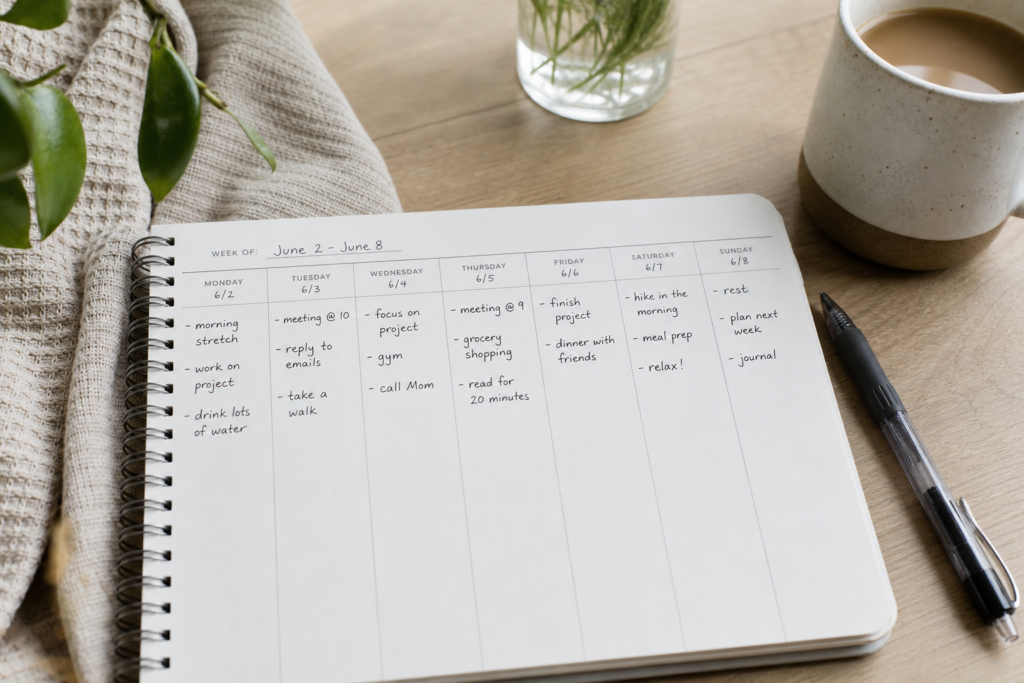
Check your real-life constraints before you commit
This is the part most goal-setting articles skip.
Before you decide what your goal is, ask:
- How many spare hours do I actually have each week?
- What part of my week is already stretched thin?
- What will this goal cost in time, money, attention, or sleep?
- What tends to throw me off: illness, travel, kids’ schedules, low mood, late work?
Kellogg Insight points out that everyone has the same 168 hours in a week. That’s a useful reality check. If your resolution needs 10 extra hours a week and you don’t know where those hours are coming from, the plan isn’t ready yet.
Try this quick exercise:
- Write your goal.
- Estimate the weekly time it needs.
- Figure out exactly where that time will come from.
- If you can’t find it, shrink the goal.
Example:
“I want to work out 5 days a week for 45 minutes.”
That’s nearly 4 hours, before travel, showering, or prep. If your mornings are rushed and your evenings are unpredictable, that plan may not survive real life.
A more realistic version might be:
“I will do a 12-minute home workout on Tuesday and Thursday, and take a 20-minute walk on Saturday.”
Less dramatic, yes. Much easier to repeat, also yes.
Make your goal approach-oriented, not just about stopping something
Research on New Year’s resolutions suggests that approach-oriented goals work better than avoidance goals. In a 2020 study of 1,066 participants, people with approach goals did better after one year than those with avoidance goals, 58.9% compared with 47.1%.
So instead of saying:
- Stop wasting money
- Stop eating sugar
- Stop procrastinating
Try:
- Transfer $25 a week into savings
- Eat fruit or yogurt for an afternoon snack
- Work on the hardest task for 10 minutes at 9 a.m.
This gives your brain something clear to do, instead of just something to avoid.
Link the big why to the small how
It’s easier to keep going when your goal has both meaning and mechanics.
One study indexed in PubMed found that pairing a bigger “why” goal with smaller action steps helped increase effort over time. In plain English, that means you need both:
- The why: what this goal gives you
- The how: what you will actually do this week
For example:
- Why: I want less financial stress.
- How: I will review my spending every Sunday for 15 minutes and cancel one unused subscription this month.
- Why: I want more energy and a steadier mood.
- How: I will go to bed by 10:45 p.m. on weekdays and put my phone on charge outside the bedroom.
If you skip the “why,” the goal can feel flat. If you skip the “how,” it stays a nice intention.
Start embarrassingly small
If a goal keeps falling apart, the first step is probably still too big.
Mayo Clinic gives a helpful example: rather than jumping straight to walking 30 minutes every day, start with 15 minutes at lunch, 3 days a week, for the next month. The American Heart Association also recommends modest, manageable starts, even 10 to 15 minutes a day of movement.
That same principle works for almost any kind of resolution:
- Want to save money? Start with $10 or $25 a week on auto-transfer.
- Want to journal? Write three lines, not three pages.
- Want a cleaner home? Reset one room for 5 minutes every evening.
- Want better mental health habits? Pick one tiny anchor habit after breakfast.
If you’re drawn to that tiny-steps approach, tiny habits for better mental health when tired is a good next read.
Small does not mean pointless. Small means repeatable.

Build the goal into your environment
Motivation is unreliable. Friction matters more.
Ask yourself: what would make this goal easier to start without needing a pep talk?
For health goals
- Lay out walking shoes the night before.
- Keep a water bottle on your desk.
- Buy 2 or 3 easy breakfast options you’ll actually eat.
For money goals
- Automate savings on payday.
- Remove saved card details from impulse-shopping sites.
- Set a weekly 15-minute budget check-in.
For focus and productivity goals
- Open the document you need before you finish work the day before.
- Put your phone in another room for the first 20 minutes of a task.
- Keep a short written next-step list, not a huge to-do dump.
If home life feels chaotic enough that any new habit seems hard to start, how to stop feeling overwhelmed at home may help you create a little more breathing room first.
Plan for setbacks before they happen
One of the most useful things you can do is assume life will interrupt you.
Mayo Clinic recommends identifying barriers in advance. That matters because setbacks are rarely surprising. Usually, they’re predictable.
Try a simple “if-then” plan:
- If I miss my morning walk, then I will do 10 minutes after dinner.
- If I overspend one weekend, then I will review my budget on Sunday instead of avoiding it.
- If I get sick or exhausted, then I will switch to the minimum version of the habit for a week.
This keeps one bad day from turning into “I ruined the whole thing.” Missing once is a detour. Quitting is a separate choice.
If your energy has been low lately, don’t ignore that when setting goals. Articles like signs you need emotional rest or winter self care ideas for adults who feel drained can help you tell the difference between needing discipline and needing recovery.
Track progress in a way you’ll actually keep up
You do not need a perfect planner, a color-coded spreadsheet, or an expensive app.
Cleveland Clinic recommends tracking progress because seeing your data can support motivation. But the best tracking method is the one you won’t abandon after 10 days.
Good low-effort options include:
- A paper calendar with a check mark
- A note on your phone
- A habit-tracking app with one or two habits only
- A weekly review in your journal
Track the behavior, not just the result.
For example:
- Track “moved my body 3 times this week,” not only “lost weight”
- Track “saved $25 this week,” not only “built a full emergency fund”
- Track “read 40 pages,” not only “finished 20 books this year”
Behavior is within your control. Outcomes often take longer.
Use accountability, but keep it light
Some people do much better when someone else knows what they’re trying to do. Cleveland Clinic cites research suggesting that people who send weekly updates to an accountability partner are more likely to reach their goals than people who try to do it alone.
This doesn’t need to be intense. You could:
- Text a friend every Friday with a one-line update
- Share your savings goal with your partner
- Do a weekly walk with a neighbor
- Check in with a coach, therapist, or support group if the goal is tied to your wellbeing
For mental health, money, or health concerns that feel bigger than a self-help system can solve, it’s wise to get support from a qualified professional.
Examples of realistic New Year goals
Here are a few examples that are modest, clear, and easier to maintain:
Health and fitness
- Walk for 15 minutes after lunch on Monday, Wednesday, and Friday for the next 4 weeks.
- Do one 10-minute stretch video every Tuesday and Thursday morning.
Money
- Transfer $25 into savings every payday starting this month.
- Track every grocery trip in a notes app for 30 days.
Sleep
- Put your phone on charge outside the bedroom by 10:30 p.m. on weeknights.
- Wake up at the same time on weekdays for the next 2 weeks.
Productivity
- Work for 15 minutes on the most important task before checking email.
- Plan tomorrow’s top 3 tasks before ending work today.
Relationships
- Send one thoughtful message to a friend every Sunday.
- Have one phone-free dinner with your partner each week.
Notice what these have in common: clear action, small scope, and a built-in rhythm.
Remember that January 1 is optional
If you need a week to think, rest, tidy your schedule, or make a proper plan, take it. Mayo Clinic says there is nothing magical about January 1.
Starting later with a realistic plan is much better than starting on time with a fantasy version of your life.
If you want help resetting before you set goals, try this end of year life reset checklist. A calmer starting point can make your goals easier to carry.
A simple formula you can use today
If you want one easy template, use this:
I want to [bigger outcome] because [why it matters]. For the next [time period], I will [small specific action] on [days/time]. If [likely obstacle] happens, I will [backup plan].
Example:
I want to save more money because I want less monthly stress. For the next 8 weeks, I will transfer $25 into savings every Friday and review my spending for 10 minutes on Sunday. If I miss a week, I will restart the next Friday without trying to “make up” for everything at once.
That’s realistic. And realistic is what gives a goal a real chance to last.
Pick one goal today, shrink it one more time than feels necessary, and write down your first step for this week. That’s enough to begin.
Frequently Asked Questions
How many New Year’s goals should I set?
Usually, fewer is better. One main goal and one supporting goal is often enough. If you try to overhaul your health, finances, productivity, and relationships at the same time, you spread your time and energy too thin. A smaller list gives each goal a real chance.
What makes a New Year’s goal realistic?
A realistic goal is specific, small enough to fit your actual week, and clear about when and how you’ll do it. It also accounts for your current energy, money, schedule, and responsibilities. If you can’t picture where it fits in your life, it’s probably still too big.
Is it better to start on January 1?
Not necessarily. January 1 can be a useful marker, but there is nothing special about that date if you don’t have a solid plan yet. Starting a few days or weeks later with a clear, manageable goal is often more helpful than rushing into an unrealistic resolution.
How do I keep my New Year’s resolutions after January?
Keep the habit small, track it simply, and plan for interruptions ahead of time. It also helps to use approach goals, such as “walk three times a week,” instead of avoidance goals like “stop being lazy.” Weekly check-ins and light accountability can make a big difference.
What should I do if I already fell behind on my goal?
Don’t restart from scratch or punish yourself with a bigger plan. Look at what got in the way, shrink the habit if needed, and begin again with the next available step. Falling behind does not mean you failed. It usually means your plan needs to be easier to sustain.