
Self Care Checklist for Stressful Weeks
A good self-care checklist for stressful weeks should stick to the basics you can actually manage when you’re tired: sleep, food, water, movement, boundaries, calming breaks, and support. Start with the essentials, then add optional extras only if you have the energy.
That matters because a stressful week is not the time to build a perfect routine. It’s the time to limit the damage, protect your energy, and keep yourself functioning as gently as you can.
Start here: the bare-minimum checklist
If your week feels like too much, don’t aim for your ideal version of self-care. Aim for this:
- Sleep: give yourself a real shot at 7 or more hours.
- Hydration: drink water regularly throughout the day.
- Food: eat something with protein, carbs, and color at least a few times a day.
- Movement: do 10 to 30 minutes of walking, stretching, or other light movement.
- Boundaries: drop, delay, or say no to at least one nonessential task.
- Input control: take a break from news or social media if it’s making you more tense.
- Calming reset: do 2 to 10 minutes of deep breathing, stillness, prayer, stretching, or quiet.
- Support: reply to one trusted person, or reach out to one.
If you only manage half of that, it still counts. The goal is not to win the week. It’s to get through it without abandoning yourself.
Essentials first, optional extras second
One reason self-care can feel irritating during stressful times is that it’s often framed as more to do. A bath, a gratitude practice, a digital detox, a yoga class, a tidy kitchen, a perfect bedtime routine. Helpful sometimes, sure. Realistic every hard week? Not really.
A better approach is to split self-care into two levels.
| Level | What belongs here | Why it matters |
|---|---|---|
| Essentials | Sleep, food, water, medicine if prescribed, movement, boundaries, basic hygiene, support | These protect your physical and mental baseline. |
| Optional extras | Face masks, long journaling sessions, elaborate meal prep, deep decluttering, spa-style treats | Nice if they help, but they are not the foundation. |
That’s the shift. During a rough week, self-care is less about adding treats and more about keeping the basics from falling apart.
For a lot of people, that also means shrinking expectations. If you normally do a full morning routine, maybe this week your version is just water, clothes, breakfast, and one slow breath before checking your phone. That’s still a routine.
If you need ideas that stay intentionally small, this guide to tiny habits for better mental health when tired can help.
Daily self care checklist for stressful weeks
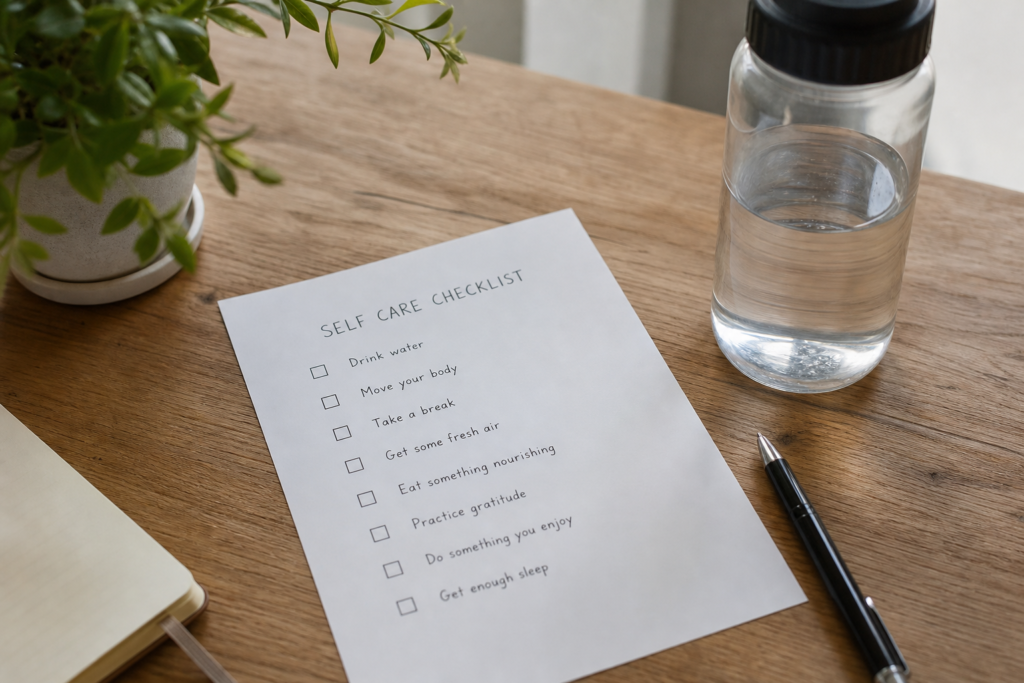
Use this as a copy-and-go list. You do not need to complete every item every day.
1. Sleep: protect the next night, not just the current day
Adults need at least 7 hours of sleep a night, and many people don’t get it. During stressful weeks, low sleep tends to make everything louder: irritability, brain fog, cravings, and emotional reactivity.
- Set a realistic bedtime, not an aspirational one.
- Keep wake-up time roughly consistent if you can.
- Cut off doomscrolling 30 to 60 minutes before bed.
- Lower the bar for your evening. Clean face, brush teeth, phone away, lights down.
If nights are where things unravel, read this bedtime routine for overthinking adults or how to stop doomscrolling at night and sleep better.
2. Food: aim for steady, not perfect
Stress can push eating in both directions. Some people skip meals without noticing. Others graze all day and still feel unsatisfied. Try to make food easier, not stricter.
- Eat within a few hours of waking if you tend to crash by late morning.
- Keep 3 to 5 low-effort foods around: yogurt, eggs, toast, soup, fruit, nuts, rotisserie chicken, microwave rice, frozen vegetables.
- Pair carbs with protein when possible. Think toast and peanut butter, rice and beans, apple and cheese.
- If cooking feels impossible, build meals from parts instead of recipes.
A supportive plate doesn’t have to be impressive.
3. Hydration: make it visible
This sounds basic because it is. Stressful weeks make people forget basic things.
- Fill one bottle in the morning and keep it near you.
- Drink water with meals.
- Have a glass before your second coffee if caffeine makes you jittery.
4. Movement: count the easy version
You do not need a hard workout for it to help. The CDC recommends building up to 150 minutes of moderate activity a week, and the NIH notes that a 30-minute walk can help mood and stress. But in a hard week, even 10 minutes beats zero.
- Walk around the block.
- Stretch while the kettle boils.
- Take phone calls standing up.
- Do one song’s worth of movement in the kitchen.
If your mornings tend to set the tone, you might also like a low dopamine morning routine for a calmer day.
5. Hygiene: keep one anchor habit
When stress is high, even small care tasks can feel strangely hard. Pick one non-negotiable hygiene anchor, then build around it if you can.
- Shower or wash your face.
- Brush your teeth morning and night.
- Change into clean clothes, even if they’re soft home clothes.
These habits don’t solve stress. They can help you feel more present and a little less like the week is swallowing you whole.
6. A five-minute reset: breathe, sit, or step outside
The CDC and NIH both recommend simple calming practices like deep breathing, stretching, and mindfulness. This doesn’t have to turn into a long meditation session.
- Breathe in for 4, out for 6, for 2 minutes.
- Sit outside without your phone.
- Stretch your neck, shoulders, hips, and hands.
- Pray, journal one page, or sit in silence.
If your mind is especially crowded, try how to declutter your mind when it feels like too much or use a few journaling prompts for when you feel stuck.
Weekly checklist: what to do once or twice during the week
Some forms of self-care don’t need to happen every day. Once or twice during a stressful week is enough.
- Look at your calendar and trim it. Move one thing. Cancel one thing. Decide what can wait.
- Ask for help with one practical task. Childcare swap, meal pickup, deadline extension, shared errand.
- Do a basic reset of one space. Clear the kitchen counter, make the bed, or empty your bag.
- Keep one enjoyable thing in your week. A comedy episode, a walk with a friend, a hobby for 20 minutes. The APA notes that dropping all enjoyable activities can backfire.
- Check your spending and coping. Stress shopping, extra alcohol, and impulse habits can sneak up fast.
This is also a good time to notice whether what you need is not more productivity, but more rest. These signs you need emotional rest may help you tell the difference.

What to stop doing during a stressful week
Self-care is not only about what you add. It’s also about what you reduce.
Cut back on excess input
If you’re checking headlines, messages, and social feeds all day, your nervous system rarely gets a pause. The CDC recommends taking breaks from news and social media when constant exposure becomes upsetting.
- Turn off nonessential notifications.
- Choose two times a day to check the news instead of grazing all day.
- Move social apps off your home screen for a few days.
Stop treating every task as urgent
The NIH recommends deciding what must get done, what can wait, and when to say no. During a stressful week, that skill is self-care.
- Must do
- Should do
- Can wait
That simple list can quiet a lot of mental noise.
Watch for numbing habits
Be honest with yourself. Are you coping, or are you checking out? Extra drinks every night, sleeping at odd hours, endless scrolling, snapping at people, or skipping meals are signs you may need more support than a checklist can offer.
A realistic 10-minute self-care plan for low-energy days
If you feel too overwhelmed to think, use this order:
- Drink a glass of water.
- Eat something simple with protein and carbs.
- Stand outside or by a window for 2 minutes.
- Text one person: “Rough week. Just saying hi.”
- Write down the top 3 things that actually matter today.
- Choose one thing to postpone, cancel, or ignore.
That’s it. Not glamorous. Very useful.
When self-care isn’t enough
Stress is a normal part of life, but long-term stress can affect both physical and mental health. A stressful week may pass with rest and support. But if your symptoms are getting worse, lasting, or making daily life hard, it’s wise to talk with a qualified health professional.
Seek help sooner if you feel unable to cope, are using alcohol or drugs to get through, or have thoughts of harming yourself. If you’re in immediate danger or thinking about suicide, call emergency services or a crisis line in your area right away.
You do not have to wait until things feel dramatic to ask for help. Sometimes the strongest move is admitting, “This has gone past what I can carry alone.”
For general stress advice, the CDC’s guide on managing stress and the NIH’s emotional wellness toolkit are both clear and practical.
A simple checklist you can copy into your notes app
Daily:
Sleep opportunity of 7+ hours
Water bottle filled
2 to 3 real meals or easy meal substitutes
10+ minutes of movement
Brush teeth and wash face
5-minute quiet reset
Limit doomscrolling
Reply to or contact one supportive personOnce or twice this week:
Trim calendar and lower expectations
Say no to one nonessential task
Tidy one small space
Keep one enjoyable activity
Notice unhealthy coping early
Ask for help if needed
Save that, use what helps, and ignore what doesn’t. The best self-care checklist for stressful weeks is the one you can still do when life is messy.
If this week has tipped into full overwhelm, you may also want to read how to stop feeling overwhelmed with life or how to stop feeling overwhelmed at home. Start with one box on the checklist today, not all of them.
Frequently Asked Questions
What should be on a self care checklist for stressful weeks?
Keep it simple and basic: sleep, hydration, regular meals, light movement, hygiene, a short calming practice, less social media or news, and some form of support. During a stressful week, the best checklist is not the most inspiring one. It is the one you can still follow when your energy is low.
What is the most important self-care when you’re overwhelmed?
Start with the essentials that affect your body and nervous system fastest: sleep, food, water, and reducing overload. Then add one small calming habit, like a short walk or two minutes of slow breathing. If you’re overwhelmed, fancy extras can wait. Basics usually help more than people expect.
How do I practice self-care when I’m too busy?
Use smaller versions. Drink water while answering emails, eat easy meals instead of skipping lunch, walk for 10 minutes instead of doing a full workout, and set one boundary instead of trying to fix your whole schedule. Self-care during busy weeks works better when it fits inside your real life.
Can self-care help with stress and anxiety?
It can help lower some of the strain, especially when it improves sleep, reduces overstimulation, and gives your body regular fuel and rest. But self-care is not a cure-all. If stress or anxiety keeps building, lasts for weeks, or affects work, relationships, or safety, talk with a qualified professional.